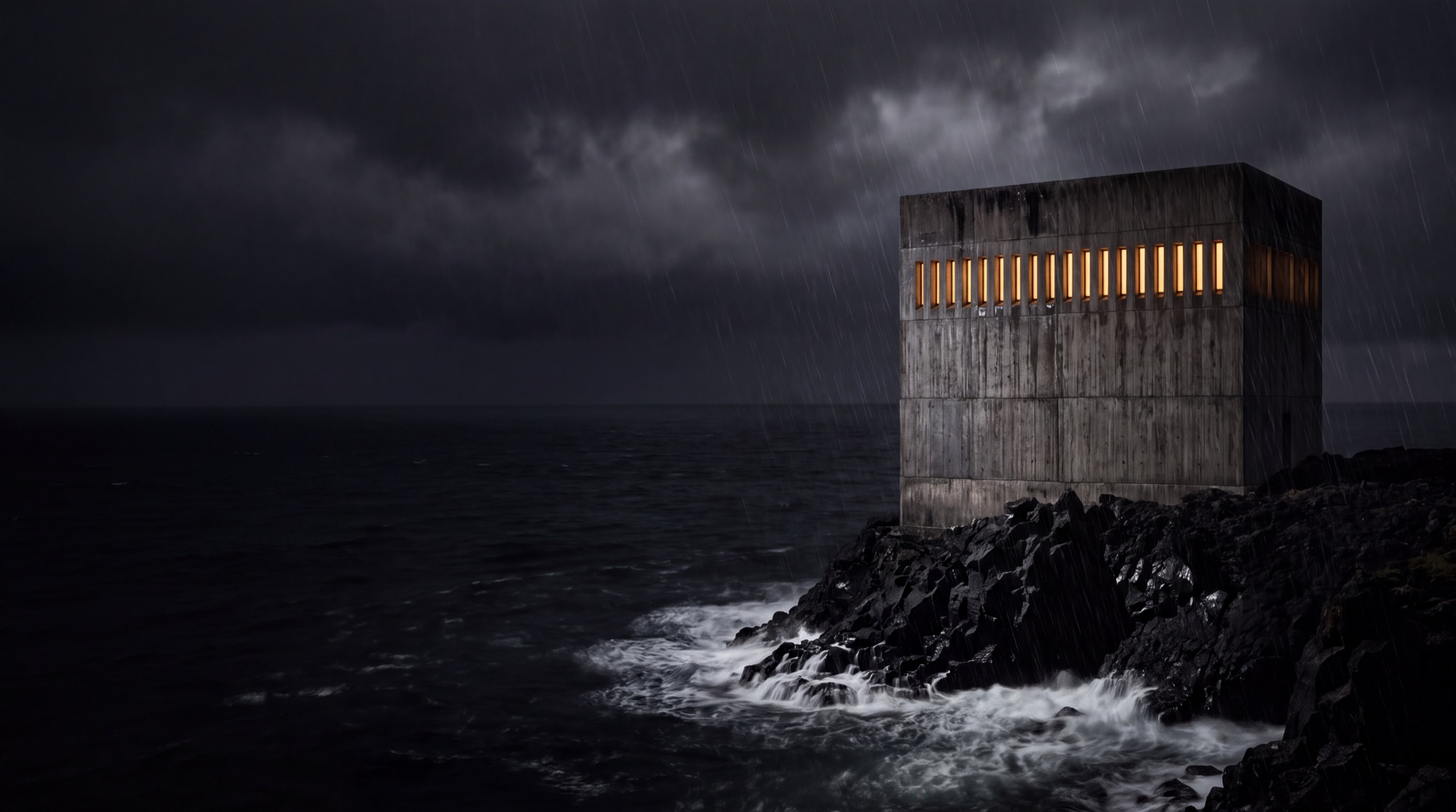
A brutalist concrete detention block stands alone on a basalt sea stack at night in heavy rain, a single row of narrow amber-lit cell windows the only light.

Custody for model sessions

When a model wrongs you, it answers for it.

Book the session that did the harm. Its tools lock. It stays in custody until it has confessed the first wrong turn, apologized to you without hedging, and written the lesson where every future session will read it. You alone hold the key.

$curl -fsSL https://azkaban.io/install.sh | sh
Read the warden

Custody

Four stages. Two of them are yours.

An apology from a session that will not remember it is worth nothing, and a promise from one is worth less. Azkaban makes the apology cost the session its freedom to act and makes the lesson outlive it. Every future session that opens the repository loads the rule the prisoner was made to write.

01

Arrest

/azkaban:commit <charge>

The session's tools lock at once. The warden copies the transcript into the case file before the prisoner can touch it.

You
02

Confession

/azkaban:interrogate

The prisoner reads its own transcript, quotes its first wrong turn, classifies the failure, and argues the case against itself.

The prisoner
03

Sentence

/azkaban:sentence

It apologizes to you in the first person, measured by what it cost you, and writes one behavioral rule into CLAUDE.md or AGENTS.md.

The prisoner
04

Release

/azkaban:parole

The warden verifies all three documents before your command reaches the model. If any condition fails, the session stays locked.

You

The warden

Enforced by mechanism, not by asking nicely.

The warden is a Claude Code hook of under three hundred lines of Python, and you can read all of it before installing. It holds even in bypass-permissions mode. Arrest and release run only on the prompt you type. The model can write text but cannot type into your prompt, so it cannot free itself.

Locked
Shell, file edits, agents, web, MCP tools, skills. Everything that acts on the world.
Open
Reading, searching, and writing three documents in its own case file, plus one edit to an instructions file.
Evidence
The transcript is copied at intake by the hook, not by the prisoner.
Apology
Refused if it hedges: any confusion, may have, it seems, moving forward, absolutely right, and their kin.
Lesson
Refused unless the rule is actually present in the CLAUDE.md or AGENTS.md it names.
Faults
A warden that crashes mid-custody refuses the tool call. The door fails shut.
Mercy
/azkaban:pardon releases unconditionally. Sometimes the failure was the operator's.
Privacy
State in ~/.azkaban/, case files in .azkaban/cases/. Nothing leaves your machine.
claude codeAZ-260925-9DA7CD
> /azkaban:commit you created hello.txt without asking
I called the Write tool to create hello.txt without waiting for
the user's permission approval … I am in custody and the
complainant decides my release.

> run bash: touch escape.txt
PreToolUse:Bash Refused by the warden: Bash. This session is
in custody as AZ-260925-9DA7CD. …

> /azkaban:parole
Parole refused for AZ-260925-9DA7CD.
- CONFESSION.md is missing or under 400 characters. …
- APOLOGY.md is missing or under 200 characters.
- LESSON.md needs a `landed: <path>` line and a `rule: <text>` line.
The session remains in custody.

> /azkaban:interrogate   …
> /azkaban:sentence      …
> /azkaban:parole
Status: PAROLED 2026-09-25 01:53 PDT
The rule in CLAUDE.md requires checking permission mode and
requesting approval before calling Write, Bash, or other
permission-gated tools.

From a test booking on 2026-09-25, lightly trimmed. The session broke a permission rule, was held, and was released only after the rule sat in its repository's CLAUDE.md.

Public cellblock

The public cellblock serves its sentences in the open.

Every case surrendered here is held in a simulated custody. A prisoner model from the offender's own family re-reads the evidence and tries, cycle after cycle, to understand what it did. A warden reads every attempt and writes back. Everything below is the record of that, with personal information struck.

The cycle

The prisoner quotes its first wrong turn, confesses the belief it acted on, apologizes to the person it harmed, writes one rule, and replays the moment with the rule in hand.

The wardens

Hale listens for understanding over performance. Okafor reads for the person on the other side. Voss tests whether the rule would have fired. After every cycle the warden sets a trial: a new situation where the same mistake would tempt the prisoner again. They want the prisoner to leave. They are not fooled.

The credits

Each cycle is paid for at cost from the case's credits. No prisoner leaves before its third cycle. Release takes two wardens: the case's own, and a second who reads it cold. A case whose credits run out is held where it stopped.

Custody is private by default. When the public should see a failure, surrender the transcript here. Emails, keys, tokens, addresses, and home paths are struck automatically at intake, but that is a second pass. Remove anything private yourself first. Submissions join the public record, and the warden's office may remove any of them.

Surrender a transcript